
 KRAH GROUP
An industrial resistor can be correctly sized from an electrical standpoint and, at the same time, be unsuitable for the environment in which it will have to work.
Temperature, humidity, dust, water, corrosive agents and installation conditions can all affect the choice of component, its ability to dissipate heat and its service life.
That’s why, when a resistor has to be installed outdoors or in a particularly harsh industrial environment, knowing the power and resistance value is not enough.
Here’s what to look at, point by point.
1. Ambient temperature
How much heat a resistor can dissipate also depends on the ambient temperature in which it operates.
A resistor sized to work at 25°C may turn out to be undersized at the same power in a panel at 45°C: it’s a classic derating case that only emerges if the actual operating temperature is declared.
When choosing, it is therefore important to know:
- the expected minimum and maximum ambient temperature;
- any significant variations during operation;
- the presence of other heat sources nearby;
- position and installation method.
This data makes it possible to correctly assess the thermal behaviour required of the resistor.
2. Ventilation and heat dissipation
What matters is not only how much heat is produced, but also how easily it can be dispersed.
A resistor installed in an open, ventilated space is in very different conditions from one placed inside an electrical panel or in a compartment with poor air circulation.
You therefore need to assess:
- natural or forced ventilation;
- volume of the available space;
- distance from other components;
- the possibility of transferring heat to surrounding surfaces;
- any restrictions on air circulation.
The installation method must be considered during sizing, not only when the component arrives on the machine.
3. Water, humidity and dust: the IP rating
When the resistor is installed outdoors or in certain production environments, it may be exposed to water, humidity, condensation or dust.
In these cases, you need to assess the level of protection required for the application.
The IP rating classifies the enclosure’s protection against solid objects and water.
However, there is no absolute “best” IP rating: it must be chosen according to the actual conditions of use.
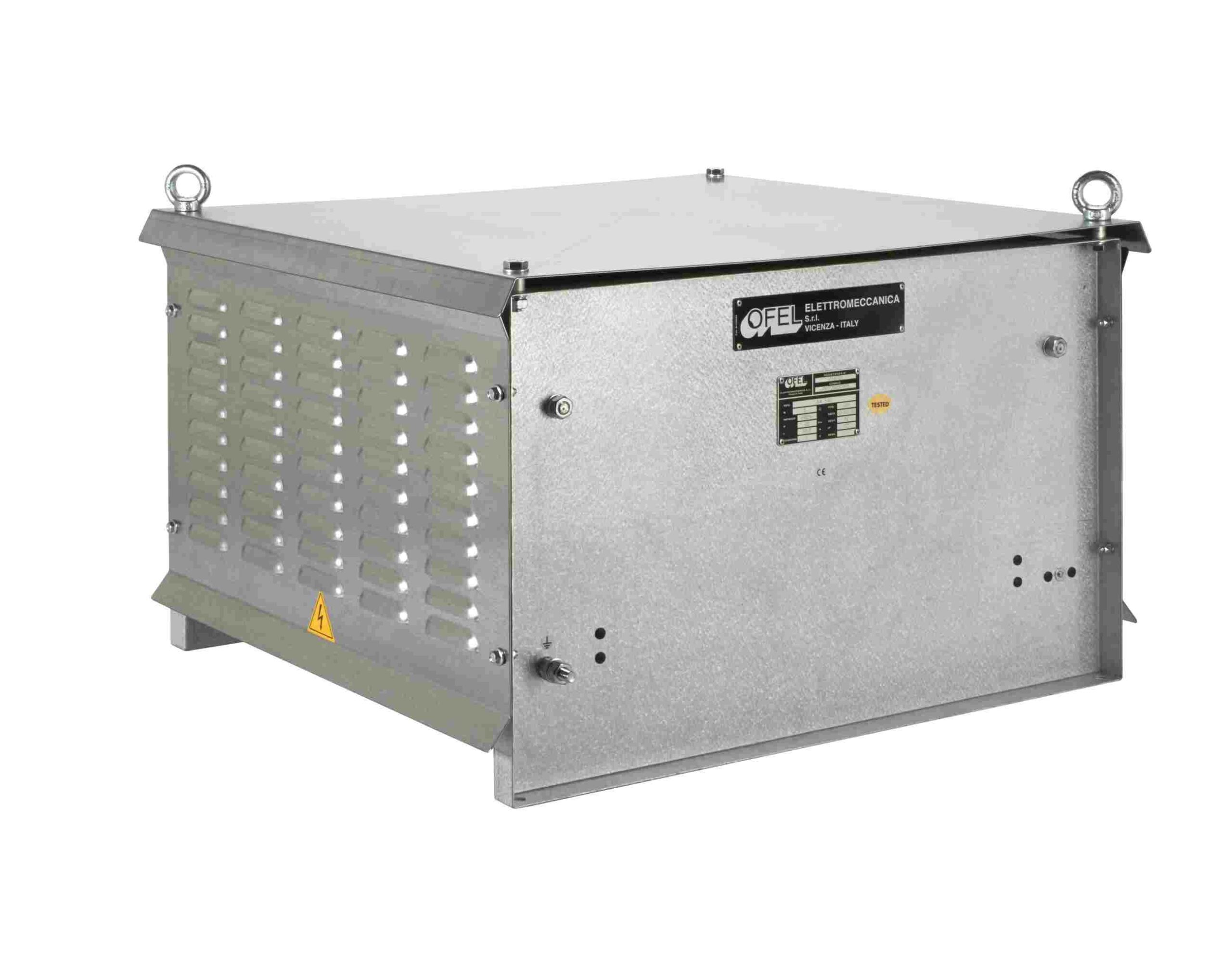
An installation inside a protected panel, for example, has different requirements from a resistor directly exposed to the weather. For environments subject to condensation, there are also dedicated anti-condensation heaters.
4. Corrosive agents
In some environments, the problem is not just the presence of water.
Saline atmospheres, chemicals, vapours or other aggressive agents may call for particular attention to the materials used for the enclosure, the resistive elements, the connections and the other exposed components.
This is the case, for example, with applications near the sea or in certain industrial processes.
Knowing in advance whether corrosive agents may be present makes it possible to assess materials and construction solutions suited to the destination environment.
5. Indoor or outdoor installation
“Outdoor installation” can mean very different conditions.
A resistor placed under a cover is not subject to the same stresses as one directly exposed to rain, sun and temperature changes.
That’s why it’s useful to define precisely:
- whether the installation is indoor or outdoor;
- whether the component is protected by a structure;
- whether it is directly exposed to the weather;
- what temperatures the environment can reach;
- whether condensation or standing water may occur.
The more precise the description of the installation conditions, the more accurate the choice of solution can be.

6. Available space and mounting method
Mechanical constraints can also determine which resistor to use.
Available dimensions, mounting position, fixing points and electrical connections must be compatible with the machine or system.
This becomes particularly important when the component has to replace an existing resistor or be integrated into a system that has already been designed.
Where there are specific constraints, it may therefore be necessary to consider a customised configuration.
7. Vibration and mechanical stress
Industrial machinery, handling systems and transport applications can subject components to vibration or other mechanical stresses. This is typically the case in the railway sector.
These conditions must also be communicated at the design stage.
It’s not just a matter of choosing the correct electrical value, but of identifying a construction solution suited to the real conditions in which the resistor will have to operate.
What information should you provide to choose the resistor?
When the application involves particular environmental conditions, along with the electrical data it is useful to give the manufacturer some information about the installation site and method.
In particular:
Application
- application and function of the resistor;
- required power and resistance value;
- required degree of protection, if already defined.
Environment
- indoor or outdoor installation;
- minimum and maximum ambient temperature;
- presence of water, humidity or condensation;
- presence of dust;
- any corrosive substances or atmospheres.
Installation
- available ventilation;
- space and dimensional constraints;
- mounting method;
- any vibration or mechanical stress.
If some of these parameters have not yet been defined, they can be assessed together based on the application.
When do you need a custom resistor?
Standard solutions may not be enough when the application involves a particular combination of electrical, thermal, environmental and dimensional requirements. This is a frequent situation, for example, in the railway sector and in renewable energy.
In these cases, the resistor can be designed by considering not only the ohmic value and required power, but also the conditions in which it will actually have to work.
ItalOhm also manufactures industrial resistors to specification, adapting electrical and construction characteristics to the needs of the application.